。線框讓檢查線穿過時仍然清晰%20--%3e%3cpath%20d='M84%2050%2067%2079.44%2033%2079.44%2016%2050%2033%2020.56%2067%2020.56Z'%20fill='none'%20stroke='%2316181A'%20stroke-width='9'%20stroke-linejoin='miter'/%3e%3c!--%20檢查線的留白暈圈:跨過任何線條時都保持可辨,單色版也成立%20--%3e%3crect%20x='41'%20y='30'%20width='18'%20height='64'%20fill='%23F2F2F0'/%3e%3c!--%20扭力檢查線:從螺帽中心畫出,跨過邊緣落到底座%20--%3e%3crect%20x='44.5'%20y='33'%20width='11'%20height='59'%20fill='%23C8102E'/%3e%3c/svg%3e) SCREWKING
SCREWKING
Screw catalogue
Organised by type. Each entry says when to choose it and where it most often goes wrong — specification tables are everywhere, those two things are not.
Precision & Electronics精密與電子
Our core. Volume range M1.0–M5.0, used in electronics, optics, instruments and precision mechanisms.
Driven into an existing threaded hole or nut; does not cut its own thread
Self-Tapping Screws 鐵板牙螺絲(自攻)Cuts its own internal thread in a pilot hole; no tapping operation needed
Thread-Forming Screws 三角牙螺絲Displaces material to form the thread; produces no swarf
Type-Cutting Screws 割尾螺絲A slotted end forms a cutting edge for harder or thicker material
Construction & General建築與一般
Also produced, but mostly M4 and above. If you need small quantities of standard building fasteners, distributor stock will usually reach you faster than we will.
Drills, taps and fastens in one operation; no pilot hole
Wood Screws 木螺絲Fixes into timber and wood-based panels; coarse thread grips the fibre
Drywall Screws 乾牆螺絲Fixes plasterboard to framing; the bugle head allows the surface to be filled
How length is measured
Screw length is measured differently depending on the head, and this is the most common source of error in quoting and goods-in. The same “10 mm” differs by a whole head thickness between a countersunk and a pan head.
One rule covers it: if the head sinks into the work, measure overall; if it stays on the surface, measure under the head.
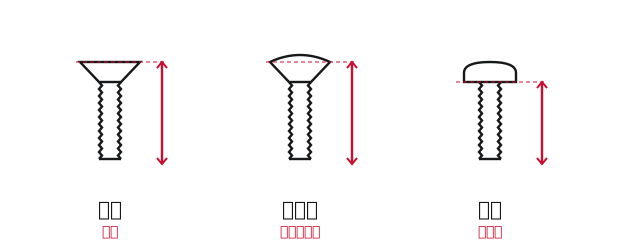
| Head style | Datum | Why |
|---|---|---|
| Countersunk (flat) | Overall length | The head sits flush in the countersink, so it counts |
| Oval (raised countersunk) | Overall to the head diameter | The cone sinks, the dome stays proud; measure to where they meet |
| Pan / round | Under head | The head stays entirely on the surface |
| Button | Under head | Same |
| Hex / hex washer | Under head | Same |
| Socket head cap | Under head | Same |
Materials
Grades and designations are set by the standards. What follows is when each one is the right choice.
-
Low carbon steelC1008 – C1022
The general-purpose default. Lowest cost, with strength coming from cold work and the finish. Around class 4.8 without heat treatment.
-
Medium carbon steelC1035 – C1045
Heat treatable. Self-tapping, self-drilling and drywall screws need hardness to cut, so they are usually this, quenched and tempered.
-
Alloy steelSCM435 / 10B21
The high-strength materials. Classes 8.8, 10.9 and 12.9 come from here. The stronger it is, the more hydrogen embrittlement matters, so the finish needs care.
-
Stainless SUS304A2
The common stainless fastener material. Adequate for general outdoor and damp indoor use. Cannot be hardened by heat treatment, so it cannot make a self-drilling point.
-
Stainless SUS316A4
2–3% molybdenum over 304, resisting chloride pitting. Needed at the coast, in chemical plant, pools and de-icing salt; elsewhere it is money spent for nothing.
-
Stainless SUS410martensitic
Hardenable, which is why stainless self-tapping and self-drilling screws are usually this. Corrosion resistance is clearly below 304.
-
Brass
Conductive, non-magnetic, decorative. Low strength — not for loaded joints.
-
Aluminium
Light and non-magnetic. Low strength, and galvanic corrosion where it meets steel.
-
Titanium
High specific strength, corrosion resistant, non-magnetic, biocompatible. Price is the constraint.
Finishes
A finish is chosen on three things at once: corrosion performance, dimensional effect, and whether it risks hydrogen embrittlement.
Hydrogen embrittlement. Above roughly 390 HV core hardness, pickling and electroplating can introduce hydrogen that causes delayed fracture under load — hours or days after assembly, not at the time.
Two remedies: bake promptly after plating, or specify a non-electrolytic zinc flake coating. On high-strength parts this belongs in the purchase specification, not left to the plater. More on plating and thread tolerance →
-
Zinc plating (trivalent)
The common corrosion finish. Low cost, fine indoors and in general outdoor use. Hexavalent chromium is being withdrawn under regulation, so “zinc plated” now generally means trivalent.
-
Hot-dip galvanisingHDG
Much heavier coating for outdoor and corrosive service. The thread is thickened by the coating, so mating nuts are usually tapped oversize.
-
Zinc flake (Dacromet / Geomet)
Far better corrosion resistance than electroplated zinc, and non-electrolytic, so no hydrogen embrittlement risk. The usual choice for class 10.9 and above.
-
Black oxide
Almost no dimensional change, matt black appearance. Very limited corrosion protection — dry environments, or oiled.
-
Nickel / chrome
Appearance and hardness. Corrosion performance depends on thickness and undercoat.
-
Phosphate
Mostly a base for paint or oil, and used on drywall screws. Weak protection on its own.
How plating consumes thread tolerance, and the M1–M1.4 case →
Drive types
Choosing the wrong drive rarely stops a screw going in. It causes cam-out, which on an automated line becomes a batch of rejects.


-
PhillipsH type
The most widespread. It is designed to cam out above a certain torque — a safeguard in the hand-tool era, a liability on an automated line.
-
PozidrivZ type
Looks like Phillips but has four additional fine ribs in the recess. Less prone to cam-out and carries more torque. The bits are not interchangeable with Phillips.
-
Slotted
The driver slips out of the slot and marks the work, and torque transfer is poor. Outside appearance or service compatibility, not worth specifying on new designs.
-
Hex socket
Good torque transfer with inexpensive tools. The recess collects debris, and six corners concentrate load — over-torque rounds them.
-
TorxTX
Six lobes give a large contact area, almost no cam-out, high torque capacity and long bit life. The first choice for automated driving and high torque.
-
External hex
Driven with a socket; the highest torque available. Needs clearance around the head.
-
Square (Robertson)
The screw stays on the bit for one-handed work. Common in North American joinery.
Enquiries
Tell us the item, size, material, finish, annual usage and application, and we will come back on feasibility and lead time. A drawing or a sample is fastest — quoting against the real part saves a great deal of guessing.
Volume range M1.0 – M5.0, standard fasteners up to M16. Minimum order From 10,000 pcs, depending on the part.