。線框讓檢查線穿過時仍然清晰%20--%3e%3cpath%20d='M84%2050%2067%2079.44%2033%2079.44%2016%2050%2033%2020.56%2067%2020.56Z'%20fill='none'%20stroke='%2316181A'%20stroke-width='9'%20stroke-linejoin='miter'/%3e%3c!--%20檢查線的留白暈圈:跨過任何線條時都保持可辨,單色版也成立%20--%3e%3crect%20x='41'%20y='30'%20width='18'%20height='64'%20fill='%23F2F2F0'/%3e%3c!--%20扭力檢查線:從螺帽中心畫出,跨過邊緣落到底座%20--%3e%3crect%20x='44.5'%20y='33'%20width='11'%20height='59'%20fill='%23C8102E'/%3e%3c/svg%3e) SCREWKING
SCREWKING
Drywall Screws
The defining feature is the bugle head: a curved underside that presses a shallow dimple into the paper without breaking it, so the joint compound can cover it flat.
Specification options
| Volume range | M1.0 – M5.0 |
|---|---|
| Maximum size | M16 |
| Standards | DIN 18182 · ASTM C1002 · ASTM C954 |
| Materials | see Materials |
| Finishes | see Finishes |
| Minimum order | From 10,000 pcs, depending on the part |
Head styles

Drive types

Choosing the thread
-
Coarse
For timber framing. Larger pitch to grip wood fibre.
-
Fine
For light steel framing. Smaller pitch so the thread does not collapse cutting thin steel.
-
Hi-lo
Alternating thread heights reduce driving torque; used in thicker or harder substrates.
Where it most often goes wrong
Each of these causes scrapped lots or rework on the floor. None of them is theoretical.
Coarse and fine swapped. The most common error on site. Coarse into steel framing will not hold; fine into timber has insufficient grip.
Driven through the paper. Once the paper face is broken that screw has no holding power and filler will not hide it. Use a depth-limiting dimpler bit.
Used structurally. Drywall screws are brittle — hardened for driving, with poor shear and tensile capacity. They hold board. They do not hang loads or make structural connections.
How length is measured
One rule covers it: if the head sinks into the work, measure overall; if it stays on the surface, measure under the head.
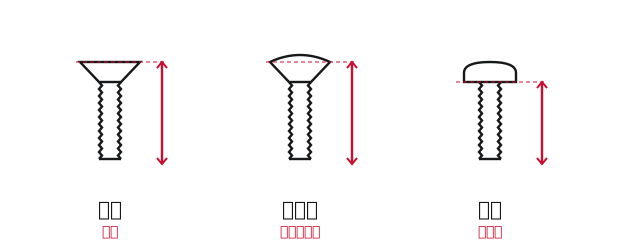
| Head style | Datum | Why |
|---|---|---|
| Countersunk (flat) | Overall length | The head sits flush in the countersink, so it counts |
| Oval (raised countersunk) | Overall to the head diameter | The cone sinks, the dome stays proud; measure to where they meet |
| Pan / round | Under head | The head stays entirely on the surface |
| Button | Under head | Same |
| Hex / hex washer | Under head | Same |
| Socket head cap | Under head | Same |
Full explanation → Where the standards stop at this size → Tolerance stack-up and the screw →
Enquiries
Drywall Screws come in a lot of combinations. Tell us the item, size, material, finish, annual usage and application, and we will come back on feasibility and lead time. A drawing or a sample is fastest — quoting against the real part saves a great deal of guessing.
Volume range M1.0 – M5.0, standard fasteners up to M16. Minimum order From 10,000 pcs, depending on the part.